Home / Commercial Roofing Services / Commercial Roof Drains and Scuppers
Commercial Roof Drains and Scuppers in Pueblo, CO
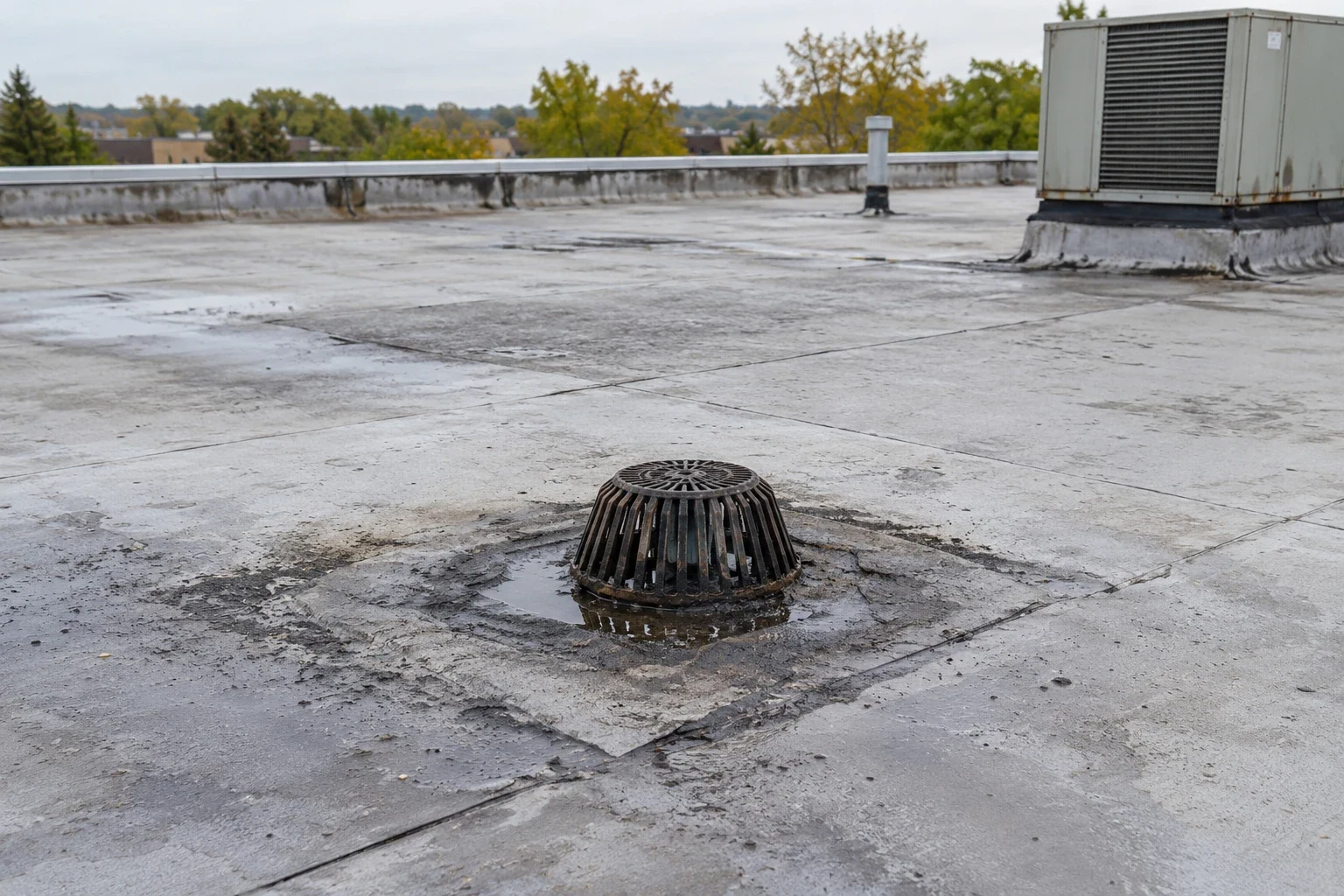
Correct commercial roof drainage in Pueblo with drain and scupper checks, cricket layout, outlet review, and a defined repair sequence.
A drain can be clear at the grate and still leave water trapped on the roof. We check the surrounding slope, bowl, clamping detail, membrane tie-in, and route to the outlet before deciding whether a cleaning, repair, or redesign is needed. In Pueblo, CO, winter snow and summer storms put attention on drainage at different times of year. The work starts with a roof-zone map and measured low points, not a drain count copied from an old plan.
The system includes more than the outlet itself. Crickets can direct water around curbs and toward drains; scuppers carry it through a parapet; gutters and downspouts move runoff after it reaches the edge. If one component is blocked or set too high, water may remain at seams or equipment bases. Buildings across St. Charles Industrial Park and the PuebloPlex campus have different roofs and outlet layouts, so every property needs its own drainage path checked in the field.
Where is water being held?
We look for ponding marks, sediment rings, algae, debris dams, low seams, and water lines around curbs or parapets. On the roof plan, we identify drains and scuppers, then compare those locations with the actual slope and insulation profile. A drain that sits above the low point may not collect water as intended. A scupper can be clear while the membrane edge leading to it has a reverse slope. We measure the condition and photograph it so the project lead can see the difference between a blocked outlet and a roof plane that needs adjustment.
Water near an HVAC curb may result from a nearby low area rather than a failed curb flashing. Similarly, a wet interior report below a drain does not prove that the drain itself is leaking. We trace the surface path, inspect the drain bowl and membrane connection, and compare the roof condition with interior observations. If a seam or penetration is open, a leak investigation can address the entry point. If the ponding pattern persists across a larger zone, we document the elevation and insulation conditions before pricing slope correction.
What does a cricket or taper need to accomplish?
A cricket should guide water around an obstruction and into a working drain or scupper. Its shape and height depend on the curb or wall, the direction of the roof slope, and the space available to meet the outlet. Tapered insulation may correct a shallow low area, but new material changes elevations at doors, parapets, and equipment. We check those transitions before drawing a correction so water does not simply collect at a new edge.
The work sequence usually begins by removing debris and confirming the outlet condition. We then inspect the drain bowl, clamping ring, surrounding membrane, and insulation; repairs may require resetting the drain, replacing wet material, adding taper, or rebuilding the flashing. Each option has different labor, material, and interruption requirements. A roof inspection can map the affected roof zone, while a recover project needs added attention to drain height because another layer can reduce the opening. The scope identifies which components are included and where concealed conditions require approval.
How does Pueblo weather test the outlet?
Pueblo averages 28.3 inches of seasonal snowfall, and severe wind and hail are tracked across the region. Snowmelt sends runoff through the drain system, while wind-blown debris can collect at strainers and scuppers. A summer downpour can show whether a low point has a route to an outlet, but a visual check does not establish the storm flow capacity of the system. We document the conditions observed and compare them with the building’s drainage design when available.
Freeze-thaw cycles can affect sealant and membrane at the drain bowl or scupper edge. A temporary patch should not block the outlet or create a new dam. We protect open areas during repair and check that the drainage path remains clear before leaving. If water is standing when the inspection begins, we record its location and depth and return under suitable conditions if that is needed to verify the correction. The roof’s slope, outlet condition, and current weather determine the drainage scope and work timing.
How do we stage drain work on an active building?
Drain repairs can require access below the roof deck as well as above it. The facility contact can identify ceiling access, plumbing routes, stored material, and rooms where a temporary shutdown would matter. On a production or distribution building, the project lead may need to coordinate lifts, loading, and interior protection. We schedule a work zone that leaves other outlets functioning and avoids opening more membrane than can be closed in the shift.
Industrial properties in Pueblo have rail and highway links, but their individual delivery routes still need review. The Pueblo airport industrial area sits beside US 50 and includes sites with direct taxiway access; St. Charles Industrial Park has rail connections and an I-25 link. We use those location facts only to prepare access questions, then confirm the actual gate and staging rules with the site. If drainage repairs are part of a replacement, a replacement sequence can coordinate taper, membrane, and edge transitions across roof zones.
What should the drainage record show?
The final record identifies each drain, scupper, cricket, or low point included in the work, along with the observed condition and completed repair. Photos show the outlet before cleaning, the membrane or clamping detail during work, and the path after closeout. If the team changed slope or insulation, the map should show the revised direction of flow. Any outlet or roof zone excluded from the project is listed so future maintenance does not assume it was repaired.
After the work, the owner should know what to check during routine visits: debris accumulation, loose strainers, sediment, water that remains beyond the expected period, or a new seam opening around the outlet. A maintenance visit can track those changes. We can add drainage findings to a condition report or include them in scheduled roof maintenance. Arrange access with the facility contact, roof plan, prior leak reports, and any interior drain-room restrictions ready. We will map the path from roof surface to outlet, define the repair boundary, and show which detail should be monitored next.
Commercial Roofing Questions
Why does water stay on the roof after the drain is cleared?
The drain may be above the low point, the insulation plane may have settled, or a curb and cricket may interrupt the path. We measure the roof surface, inspect the bowl and membrane connection, and determine whether cleaning, drain reset, taper, or another correction fits the condition.
Can a cricket be added without replacing the roof?
Sometimes. We check the existing membrane, slope, curb height, outlet location, and tie-in detail before recommending a cricket. If the surface is stable and the new taper can drain without creating another low area, localized work may be possible. Wet insulation or broad membrane failure can change that scope.
Should scuppers be checked from inside and outside?
Yes, when access allows. The roof-side opening, wall penetration, and discharge point each affect whether water can leave the roof. We look for debris, damage, and membrane separation, then coordinate any interior or exterior access needed to complete the repair safely.
What if the drain connects to plumbing below the roof?
We identify the drain assembly and coordinate below-deck access with the facility contact. If the issue involves a pipe, trap, or interior plumbing component outside the roofing scope, we document the handoff for the appropriate trade. The membrane and drain flashing are repaired as a separate roof detail.
Trace the full drainage path
Share roof plans, leak history, interior access details, and operating restrictions. We will inspect the outlet, map the low area, and identify which repair or slope work fits the roof condition.
Call 555-555-5555 or email [email protected].